
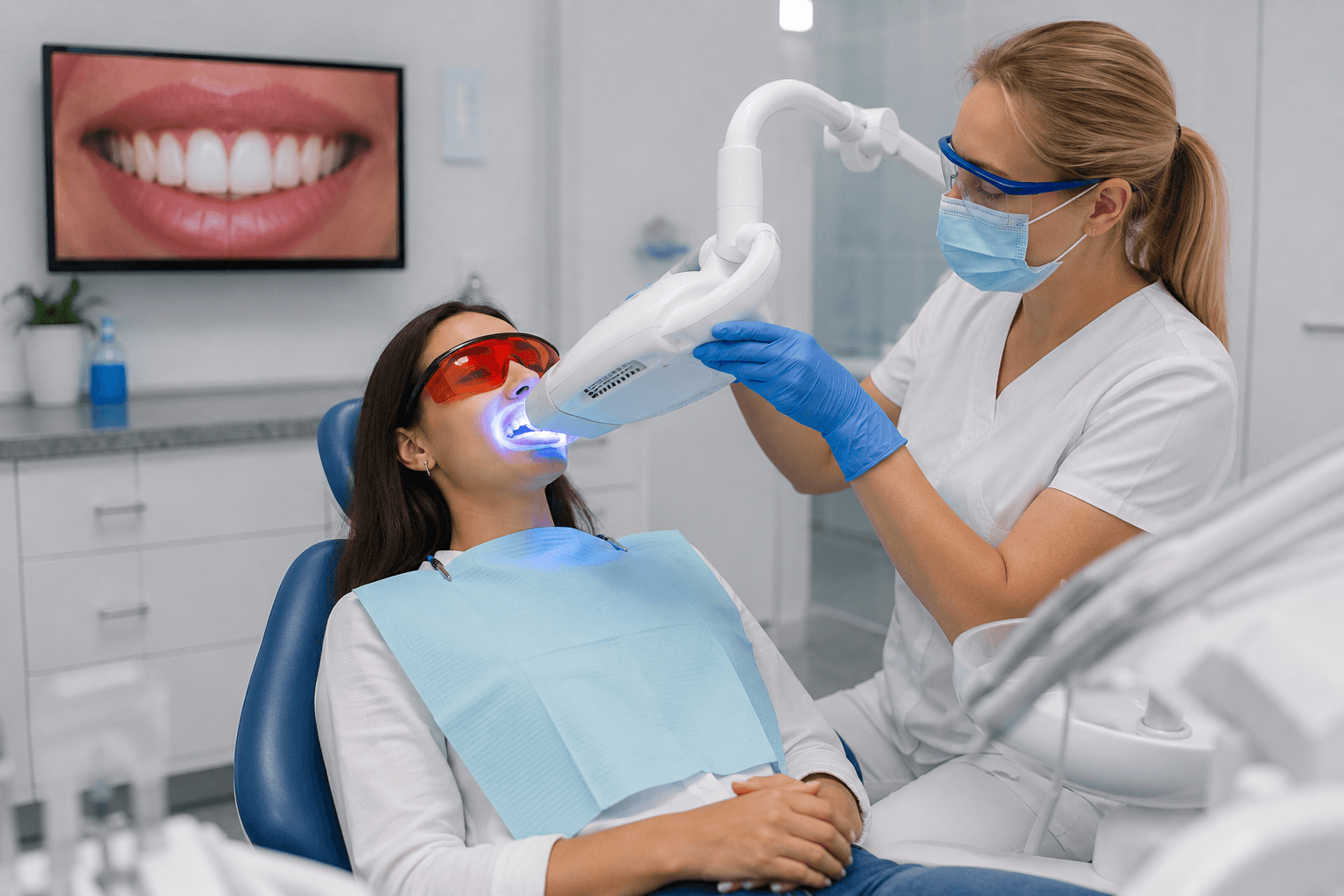
Teeth Whitening is a considered clinical service rather than a single cosmetic step. It begins with an honest assessment of enamel condition, gum health and existing restorations, continues through a carefully controlled treatment session, and ends with a maintenance plan designed to keep the result stable for as long as your habits and biology allow.
This page sets out the full service in detail. It explains what discolouration actually is and why different causes respond differently, how a professional assessment protects you from disappointment, what happens minute by minute during an appointment, and what the days and months afterwards should look like. It also covers the situations where whitening is not the right answer, because a responsible service is defined as much by what it declines to do as by what it offers.
Every section here is written to help you make an informed decision. There is no pressure and no attempt to promise an outcome that cannot be delivered. Choosing a provider that explains suitability, realistic outcomes and treatment limitations before the appointment is equally important. If you are comparing professional providers, this guide on choosing a Teeth Whitening service explains some of the factors worth considering before making a decision.
What Professional Teeth Whitening Involves
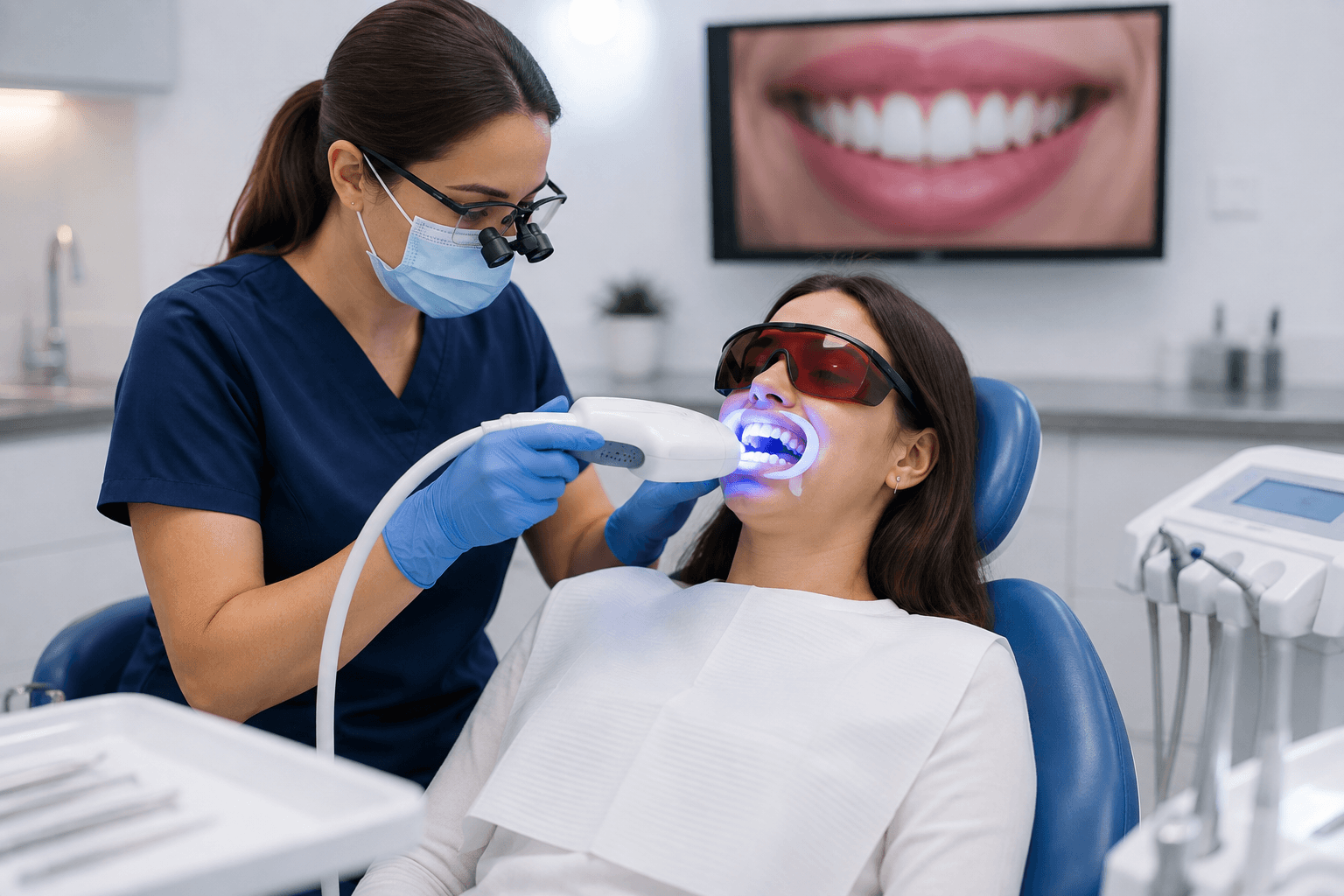
Professional Teeth Whitening is a supervised process in which a whitening agent is applied to the outer surfaces of the teeth under controlled conditions, with the gums and soft tissues protected throughout. The purpose is to lift accumulated discolouration from within and upon the enamel so that the natural tooth shade beneath becomes visible again. It is a lightening process, not a coating, and it does not add material to the tooth.
The distinction between professional treatment and unsupervised alternatives matters more than most people expect. In a professional setting, someone assesses your mouth before anything is applied, isolates the gum margins so the agent stays where it belongs, monitors the tissues during the session, and stops if anything looks unusual. That combination of assessment, isolation and supervision is what separates a predictable outcome from a gamble.
Lifting Stains Rather Than Masking Them
Discolouration sits in two broad places. Extrinsic staining accumulates on and just inside the outermost layer of enamel, deposited over years by pigmented food and drink. Intrinsic discolouration sits deeper, within the underlying dentine, and often reflects natural ageing, enamel thinning, or developmental factors present since the teeth first formed.
Whitening agents work by breaking down the pigmented molecules responsible for staining into smaller, less visibly coloured fragments. Because this happens chemically rather than by abrasion, the process does not need to scrub away tooth structure to achieve a visible change. That is an important point of reassurance for anyone who has previously relied on harsh abrasive pastes in the hope of removing stains mechanically.
Why the Whole Mouth Is Assessed First
A whitening agent acts on natural enamel. It does not act on porcelain, composite, ceramic or metal. This single fact shapes a large part of treatment planning. If you have a crown on a front tooth, a large white filling in a visible position, or a veneer, those surfaces will stay exactly the shade they are while the natural teeth around them lighten. The result can be a mismatch that looks worse than the original starting point.
Assessment identifies these situations before treatment rather than after it. In some cases the answer is to whiten first and replace the restoration afterwards to match the new shade. In others the answer is to leave things as they are. Either way, the conversation happens in advance, which is the only point at which it is genuinely useful.
What the Treatment Cannot Do
Teeth Whitening changes shade. It does not change shape, alignment, position or surface texture. It does not close gaps, straighten crowding, repair chips, or resolve wear at the biting edges. It does not treat decay or gum disease, and it should never be used as a way of avoiding treatment for either.
Being clear about these limits is not a disclaimer added at the end of a sales pitch. It is a core part of the service, because the people who are happiest with their results are consistently the people who understood beforehand exactly what they were and were not going to get.
The Consultation and Pre-Treatment Assessment
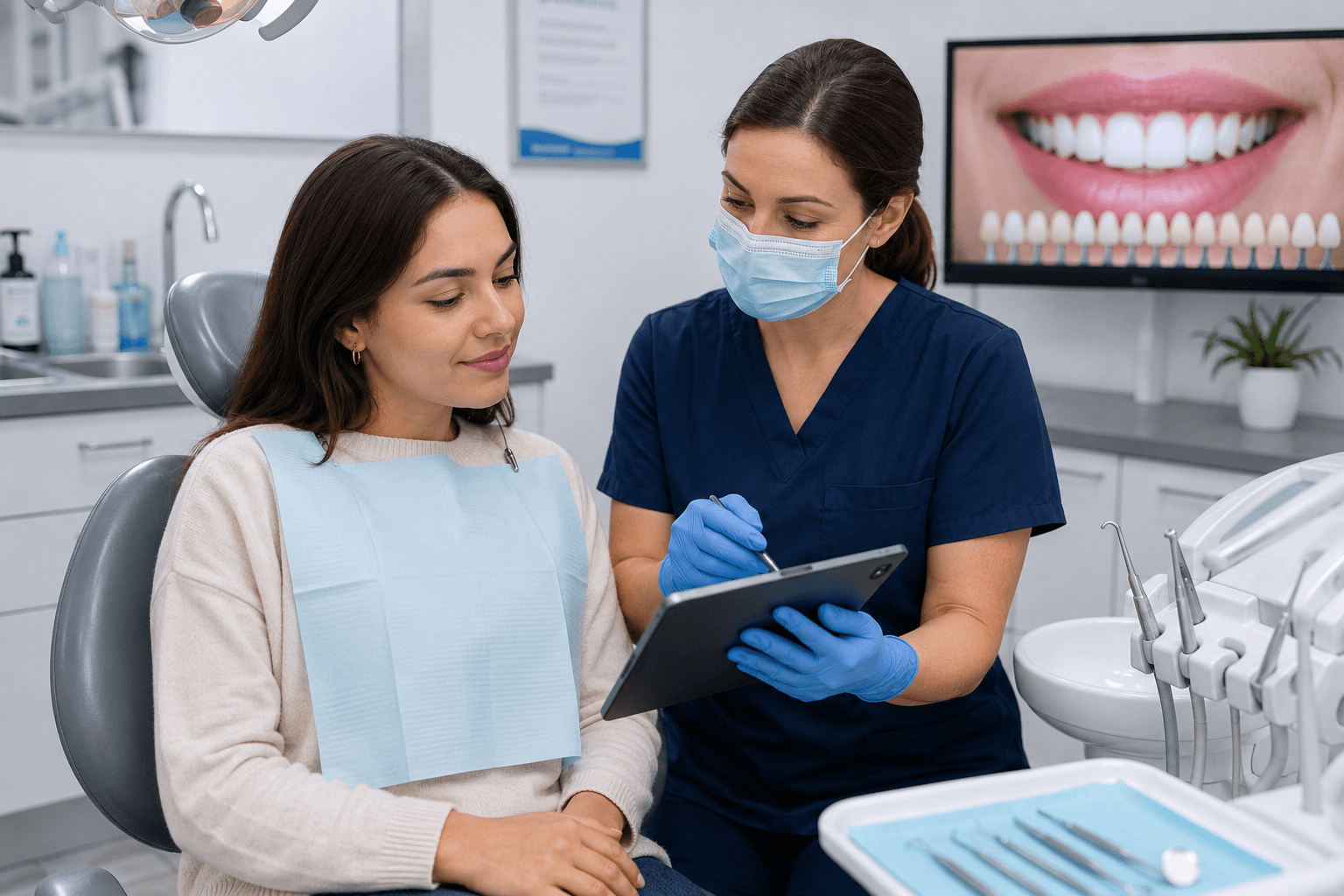
Every appropriate Teeth Whitening journey opens with an assessment. This is not a formality or a scheduling obstacle. It is the stage that determines whether treatment should go ahead at all, how it should be adjusted for your particular mouth, and what result is realistically achievable.
Medical and Dental History
A short history covers general health, current medications, allergies and any history of sensitivity. It also asks about previous whitening attempts, because someone who has recently used a strong at-home product may have teeth that are still recovering, and treating too soon can increase the chance of discomfort.
Certain circumstances mean treatment should be postponed or declined. Pregnancy and breastfeeding, active decay, untreated gum inflammation, recent oral surgery and ongoing orthodontic treatment all commonly warrant a delay. A responsible service says so plainly rather than proceeding regardless.
Examining the Teeth and Gums
The visual examination looks at enamel condition, the presence of cracks or wear facets, exposed root surfaces near the gum line, existing restorations and their positions, and the general health of the gum tissue. Gums that bleed readily, look inflamed or have receded need attention before whitening, because irritated tissue is far more likely to react uncomfortably to any agent placed nearby.
Exposed dentine at the neck of a tooth deserves particular attention. Root surfaces are not covered by enamel, respond differently to whitening agents, and are a common source of sensitivity. Identifying them in advance allows them to be protected during the session.
Recording the Starting Shade
An objective shade record taken before treatment is the only reliable way of measuring what changed. Memory is unreliable and the eye adapts quickly. Without a documented starting point, people routinely underestimate the change they achieved, simply because the new shade rapidly becomes their new normal.
The record is usually taken with a standardised shade reference under consistent lighting, and where possible a photograph is captured under the same conditions so the two can be compared directly afterwards.
Discussing Realistic Expectations
Different starting points produce different outcomes, which is why an individual assessment remains so important. Teeth with predominantly yellow or warm-toned discolouration generally respond more readily, while grey-toned or developmental discolouration can be less predictable. Patients looking for professionally delivered treatment can also explore Ultimawhite Salford for further information about professional Teeth Whitening services, treatment expectations and the whitening process.
Explaining these differences before treatment prevents the single most common cause of disappointment, which is not a poor result but a mismatch between the result achieved and the result imagined.
Inside the Appointment: What Actually Happens
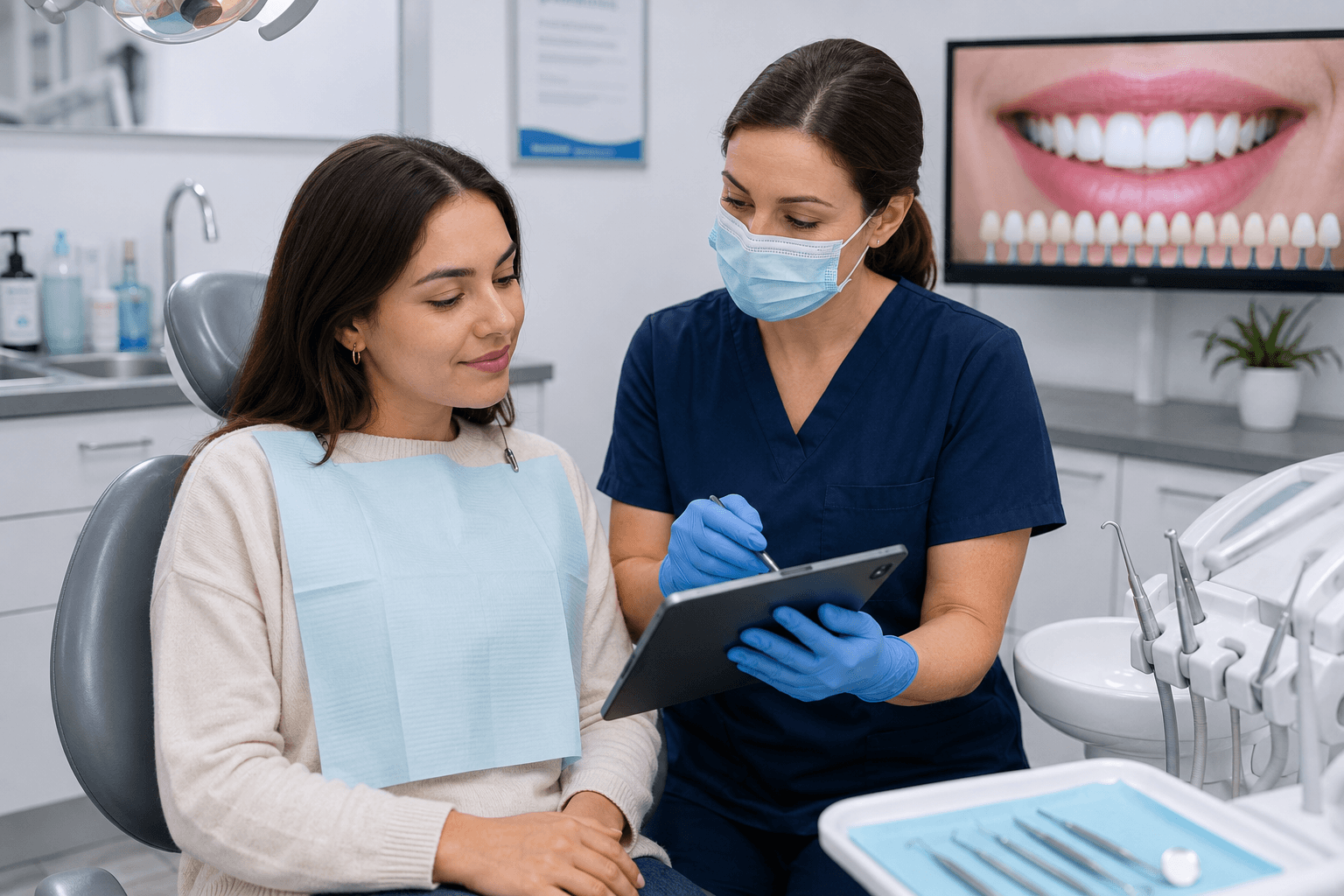
Knowing the sequence in advance removes most of the anxiety people carry into a first appointment. Nothing about the session is dramatic, and there is no stage at which anything sharp, loud or invasive is used.
Arrival and Final Checks
The session begins with a brief re-check of the mouth and a confirmation that nothing has changed since the assessment. Any new sensitivity, a recently chipped tooth or a sore area is worth mentioning at this point, because it may change how the session is run.
Cleaning and Surface Preparation
The tooth surfaces are cleaned so that the whitening agent meets enamel rather than a film of plaque or surface debris. This step alone often produces a visible improvement, because a proportion of what many people consider staining is in fact soft deposit sitting on top of the enamel. Cleaning also ensures the agent contacts every surface evenly, which is what produces a uniform result rather than a patchy one.
Isolating and Protecting the Soft Tissues
This is the stage that matters most for comfort and safety. A retractor holds the lips and cheeks clear of the teeth. A protective barrier is placed carefully along the gum margin of every tooth being treated, sealing the junction between tooth and gum. Where root surfaces are exposed or a gum has receded, extra protection is applied.
Time spent on isolation is never wasted. Almost every case of gum irritation following whitening traces back to an incomplete barrier, and a careful barrier takes only a few extra minutes to place properly.
Applying the Whitening Agent
The agent is applied in a controlled, even layer across the visible surfaces of the teeth being treated. It is left in place for a defined period while it works. Depending on the protocol, the agent may be refreshed once or more during the session, with the surfaces cleared between applications.
During this time you are simply sitting still. There is no requirement to hold your mouth in an awkward position, and if you need a pause you can ask for one. Most people find the passive nature of the session the easiest part of the whole process.
Monitoring Throughout
Your comfort is checked at intervals. The soft tissues are inspected to confirm the barrier is holding. If any discomfort develops, the session can be shortened, paused or stopped entirely. Nothing about the process requires you to endure anything unpleasant, and a service that encourages you to push through discomfort is not one worth using.
Completion and Immediate Review
At the end of the session the agent is fully removed, the barrier is lifted, and the mouth is rinsed thoroughly. The shade is recorded again against the same reference used beforehand, so the change is measured rather than estimated. Aftercare instructions are given verbally and in writing, and there is time to ask questions before you leave.
Understanding Why Teeth Discolour
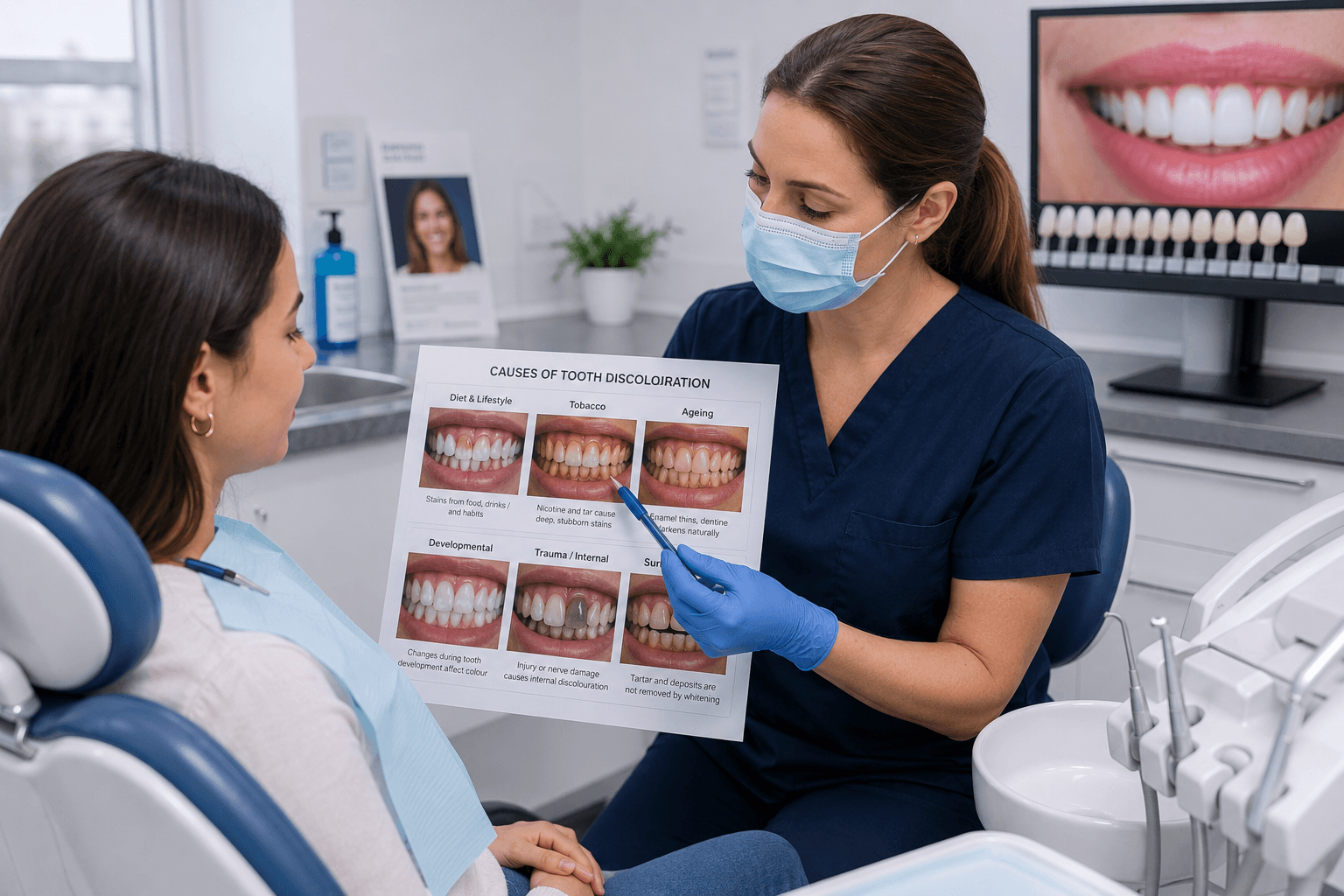
Whitening is far easier to plan when the cause of the discolouration is understood. Two people can present with teeth that look similarly dull and yet respond very differently, because the underlying reason for the colour is not the same.
Dietary and Lifestyle Staining
The most common cause is simple accumulation. Coffee, black tea, red wine, dark fruit juices, cola, soy sauce, balsamic vinegar, turmeric-based dishes and richly coloured berries all deposit pigment onto enamel. Each individual exposure is negligible; it is the repetition over years that produces the visible result. This category typically responds well to whitening, because the pigment is comparatively accessible.
Tobacco and Nicotine Products
Tar and nicotine bind readily to enamel and produce a characteristically deep, tenacious discolouration that often has a brown or orange cast. It tends to accumulate most heavily in the areas that are hardest to clean. Whitening can lift a great deal of it, though heavy long-term staining may require a more gradual approach, and results will not hold if the exposure continues at the same rate.
Natural Ageing
Enamel thins gradually throughout life while the dentine beneath it naturally darkens and becomes more yellow. Because enamel is translucent, the colour of the dentine shows through it. The combined effect means that teeth generally become warmer and darker with age even in someone with immaculate oral hygiene and no dietary staining at all. This is entirely normal and responds reasonably well, though the degree of change achievable narrows as enamel thins.
Developmental and Structural Causes
Some discolouration was established while the teeth were forming, long before they erupted. Fluorosis can produce white flecking or brown mottling. Certain childhood illnesses or medications taken during tooth development can produce banding. Enamel hypoplasia leaves areas of thin or poorly formed enamel that look and behave differently from the surrounding tooth.
These cases need honest discussion. Whitening may improve the overall background shade while leaving the patterned areas still visible, and occasionally the contrast becomes temporarily more obvious before the surrounding shade settles. Some people are delighted with that outcome and some are not, which is precisely why it is discussed beforehand.
Trauma and Internal Discolouration
A single tooth that is noticeably darker than its neighbours often reflects an old injury. Internal bleeding within the tooth, or changes following nerve damage, produce discolouration that originates inside the tooth rather than on its surface. External whitening has limited effect on this pattern. It requires a different approach entirely and should be assessed by a dentist.
Surface Deposits Mistaken for Staining
Hardened deposit at the gum line is frequently mistaken for stained enamel. It is not, and no whitening agent will remove it. It requires professional cleaning. Attempting to whiten over substantial deposit produces a poor and uneven result, which is another reason the pre-treatment assessment matters.
Twelve Reasons People Choose Professional Teeth Whitening
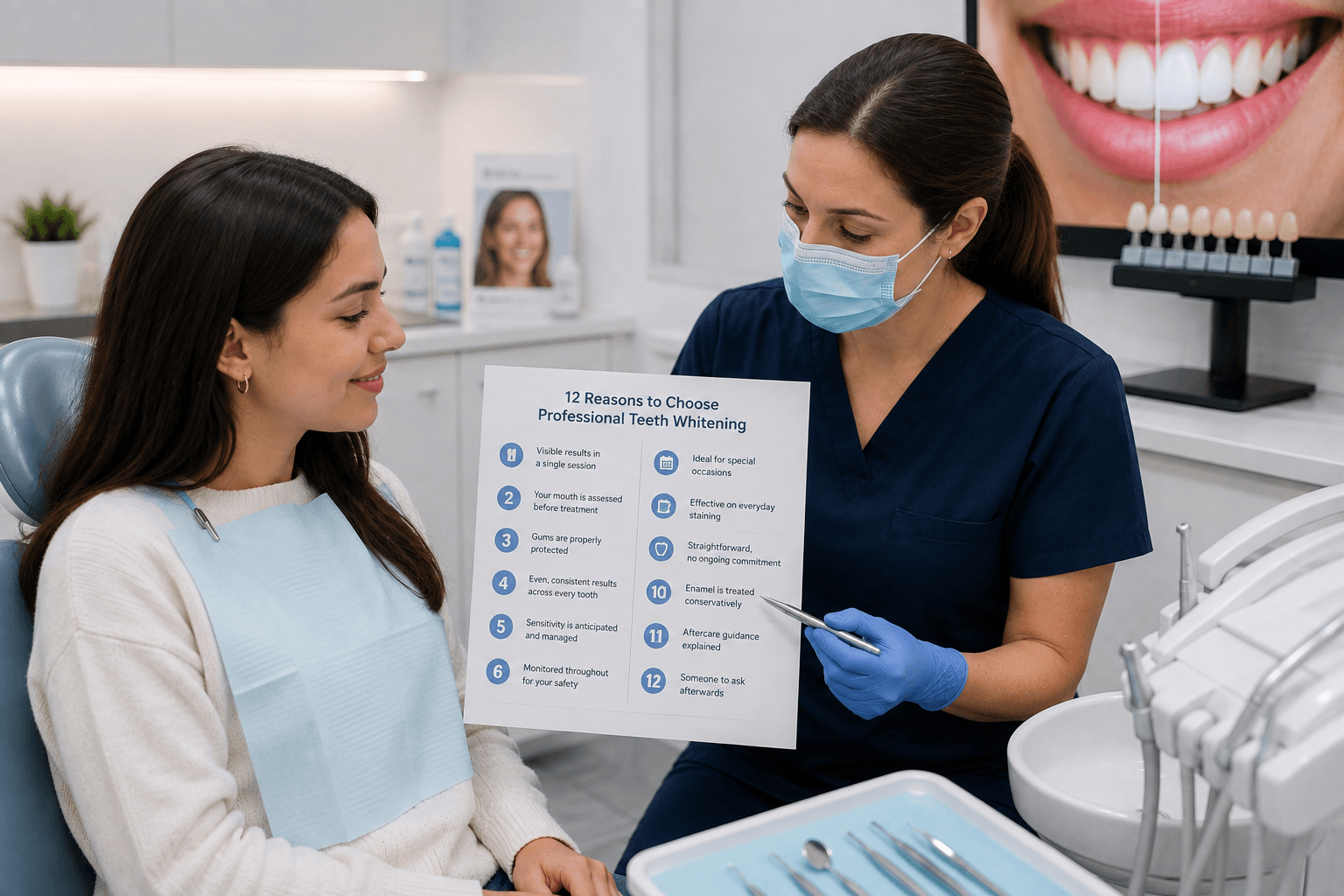
People arrive at professional Teeth Whitening from very different starting points. Some have tried supermarket products without success. Some have avoided whitening entirely because they assumed it would be uncomfortable. The reasons below reflect what people consistently say they value once they have been through the process properly.
1. The Change Is Visible Within a Single Session
A supervised in-chair session concentrates the whole process into one appointment. Rather than applying something nightly for weeks and watching for a gradual shift that is difficult to perceive day to day, the change is achieved and measured in one sitting. For anyone who has struggled to stay consistent with a long home regime, this alone is a decisive advantage.
2. Your Mouth Is Assessed Before Anything Is Applied
An off-the-shelf product cannot look at your gums, notice an exposed root surface, or spot the crown that will not lighten. A professional assessment does all three before treatment begins. Most poor whitening experiences are not caused by the agent itself but by applying it in a mouth that was not ready for it.
3. The Gums Are Properly Protected
Generic trays are not shaped to your mouth. They allow agent to escape onto the gums, which is the most common cause of the burning or blanching that people report after unsupervised whitening. A professionally placed barrier seals the gum margin tooth by tooth, which is a level of protection no mass-produced tray can offer.
4. The Result Is Even Across Every Tooth
Applying an agent evenly to your own teeth, in a mirror, without adequate lighting or retraction, is genuinely difficult. Missed areas produce patchiness that is often more noticeable than the original discolouration. Professional application under direct vision with the lips and cheeks retracted produces a consistent result across the whole visible smile.
5. Sensitivity Is Anticipated and Managed
Some transient sensitivity is a recognised possibility with any whitening process. The difference in a professional setting is that it is predicted, minimised and managed. Pre-treatment desensitising measures, appropriate protocol selection, protection of exposed root surfaces and the ability to pause or stop mid-session all reduce both the likelihood and the severity.
6. Someone Is Monitoring Throughout
If something is not right, it is noticed immediately and acted upon. At home, an unnoticed problem simply continues for the full duration of the application. Supervision is not a luxury; it is the mechanism by which small issues stay small.
7. It Suits People Preparing for a Specific Occasion
Weddings, milestone birthdays, graduations, interviews, photographs and reunions all give people a fixed date to work towards. A single scheduled session with a known outcome is far easier to plan around than an open-ended home regime with an uncertain finishing point. Booking with a sensible margin also leaves room for a review appointment if one is wanted.
8. It Addresses Everyday Accumulated Staining Effectively
The ordinary discolouration of ordinary life — years of tea and coffee, the occasional glass of red wine, the curry on a Friday — is exactly the category that responds most predictably. Many people assume their staining is unusually severe when in fact it is entirely typical and entirely treatable.
9. The Process Itself Is Straightforward
There is nothing to remember, nothing to apply nightly and nothing to keep in the bathroom cabinet. You attend, the treatment is carried out, you receive aftercare guidance and you leave. For people with demanding schedules, the absence of an ongoing daily commitment is a substantial practical benefit.
10. Enamel Is Treated Conservatively
A properly conducted whitening process lifts pigment chemically rather than removing tooth structure abrasively. This is a meaningful contrast with the habit of scrubbing hard with abrasive pastes or, worse, applying acidic home remedies found online. Enamel does not regenerate, and anything that erodes it causes permanent harm while making teeth appear darker in the long run as more dentine shows through.
11. Aftercare Guidance Is Provided and Explained
The result you leave with is only the starting point. Knowing precisely what to avoid in the first two days, and what habits sustain the result over months, makes a substantial difference to how long the change lasts. Written aftercare with the reasoning explained is far more useful than a leaflet in a box.
12. There Is Someone to Ask Afterwards
Questions arise after the appointment. Something feels slightly sensitive, or a particular food seems risky, or the result appears to be shifting. Having a named point of contact who knows your case and can answer specifically is worth a great deal, and it is not something an anonymous product can provide.
Aftercare: Protecting the Result You Have Just Achieved
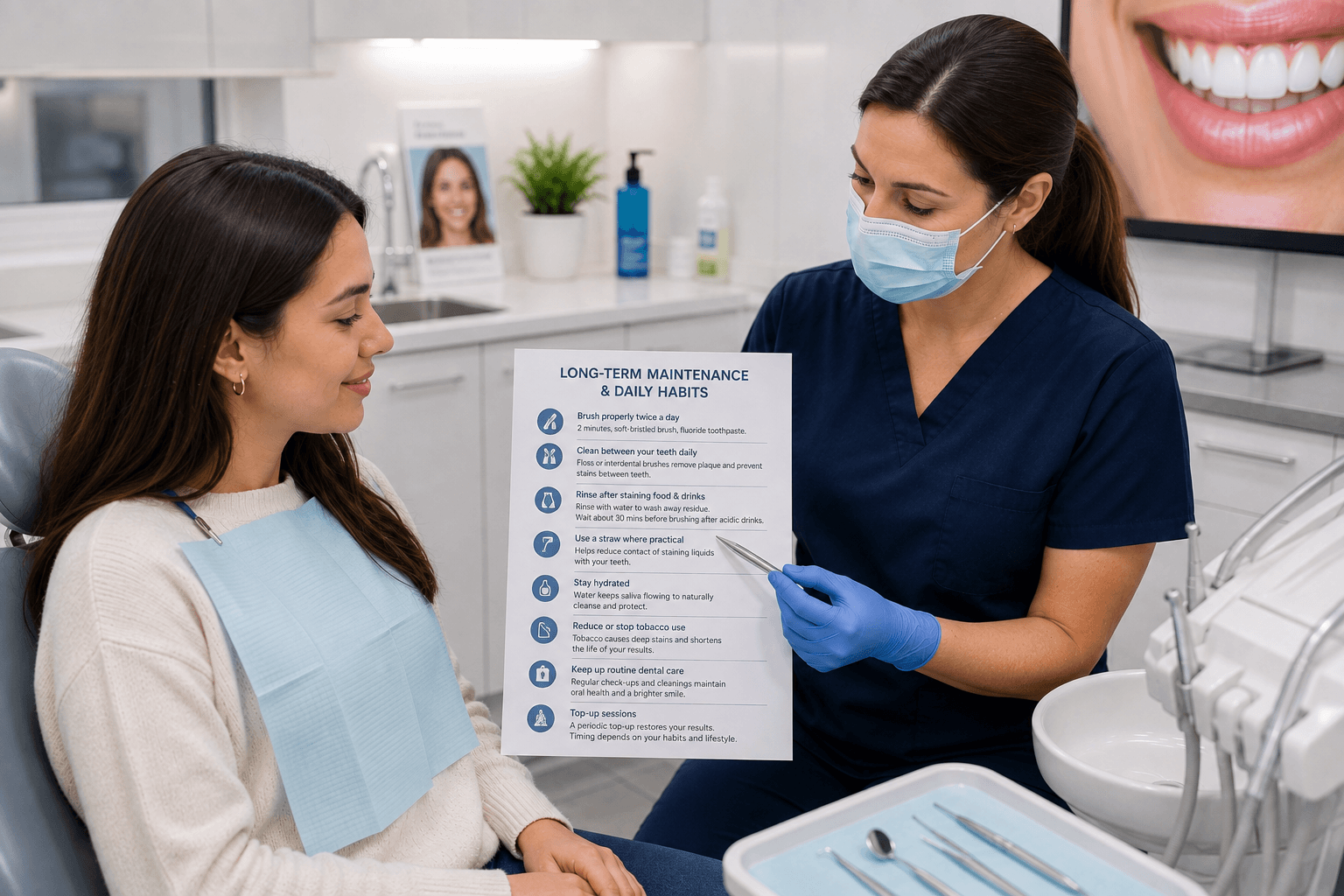
Good aftercare has a direct influence on how well a whitening result is maintained. The first forty-eight hours deserve particular attention, followed by sensible long-term habits involving oral hygiene, staining foods and drinks, hydration and routine dental care. For more detailed guidance, see this Teeth Whitening maintenance and aftercare guide, which covers practical steps for protecting the appearance of whitened teeth after treatment.
Why the First Forty-Eight Hours Matter So Much
Immediately after whitening, the outer enamel is temporarily more receptive to whatever it comes into contact with. The same accessibility that allowed pigment to be lifted out also, for a short window, allows new pigment in more readily than usual. As the enamel surface rehydrates and remineralises over the following couple of days, that receptiveness returns to normal.
This is why a strongly coloured drink consumed on the evening of your appointment can undo a disproportionate share of what was achieved that morning. It is a short window and it is entirely manageable, but it is genuinely important.
The White Diet, Explained
For the first forty-eight hours the guidance is to avoid anything strongly coloured. The most useful test is a simple one: if it would leave a mark on a white shirt, keep it away from your teeth.
Best avoided for two days
- Coffee and black tea, including iced versions and anything with a coffee base.
- Red wine, and darker beers and spirits mixed with cola.
- Dark fizzy drinks, which combine pigment with acidity.
- Curry, soy sauce, tomato-based sauces, balsamic vinegar and turmeric.
- Berries, cherries, beetroot and dark fruit juices.
- Brightly coloured sweets, ice lollies and sports drinks.
- Smoking and vaping, which reintroduce staining compounds directly.
- Coloured mouthwash and strongly coloured toothpaste gels.
Comfortable choices for the same period
- Water, still or sparkling, as the default drink throughout.
- Milk and plain yoghurt.
- Chicken, turkey and white fish, cooked without dark sauces or heavy spice.
- Rice, plain pasta, potatoes and bread.
- Cauliflower, white cabbage, peeled cucumber, courgette and mushrooms.
- Bananas, peeled apples and pears.
- Plain cheese, eggs and white sauces made without tomato.
Two days is a short and finite commitment. Most people find that planning meals in advance for that period removes any difficulty entirely, and it is far easier than attempting to correct a lost result afterwards.
Managing Any Short-Term Sensitivity
If mild sensitivity occurs it is usually short-lived and settles within a day or two without intervention. A desensitising toothpaste used consistently, moderating very hot and very cold foods for a short period, and using a soft-bristled brush gently all help. Sensitivity that is severe, or that persists well beyond a few days, should be reported rather than endured, because it may indicate something unrelated to the whitening that warrants a look.
Long-Term Maintenance and Daily Habits
Once the initial two-day window has passed, normal eating and drinking resume. Maintenance from that point onwards is not about restriction but about a small number of habits that, applied consistently, add months to how long the result holds.
Brushing Properly, Twice a Day
Two minutes, twice daily, with a soft-bristled brush and a fluoride toothpaste. The emphasis belongs on thoroughness and coverage rather than pressure. Hard scrubbing does not remove more stain; it abrades enamel and irritates gums, causing recession that exposes darker root surfaces and makes the smile look duller over time. A soft brush used carefully outperforms a hard brush used forcefully in every respect that matters.
Cleaning Between the Teeth Daily
The surfaces between teeth are where staining establishes itself most persistently, because a brush simply cannot reach them. Floss or interdental brushes reach those areas and prevent pigment building in the exact places that later show as shadowing between the teeth. Interdental cleaning also protects gum health, which underpins the entire appearance of the smile.
Rinsing After Staining Food and Drink
You do not need to avoid coffee for the rest of your life. Rinsing the mouth with water immediately after a pigmented drink clears most of the residue before it settles. It takes a few seconds and, done habitually, has a genuinely measurable effect on how quickly staining returns.
One important caution: after anything acidic, such as citrus, wine or fizzy drinks, rinse with water but wait around thirty minutes before brushing. Enamel is temporarily softened by acid, and brushing immediately can abrade it.
Using a Straw Where It Is Practical
For iced coffee, cola and dark juices, a straw reduces contact between the liquid and the front surfaces of the teeth. It is not practical for hot drinks or wine, but where it fits naturally into how you already drink something, it costs nothing and helps.
Staying Hydrated
Saliva is the mouth's own cleaning and buffering system. Adequate hydration keeps saliva flowing, which clears pigment and neutralises acid continuously throughout the day. A dry mouth, whether from dehydration, medication or mouth breathing, allows staining to establish considerably faster.
Reducing or Stopping Tobacco Use
No maintenance routine will hold a whitening result against continued heavy smoking. The staining compounds are reintroduced daily and bind readily. Reducing intake helps proportionally, and stopping entirely produces by far the largest single improvement in how long a result lasts, alongside benefits that extend well beyond appearance.
Keeping Up Routine Dental Care
Regular examinations and professional cleaning remove hardened deposit that no home routine can shift, and catch developing problems early. Whitening is a cosmetic layer applied on top of dental health; it is not a substitute for it, and it looks best on a mouth that is genuinely well maintained.
Top-Up Sessions
Shade drifts gradually over time. How gradually depends almost entirely on diet, smoking status and home care. A periodic top-up restores the result and is generally a shorter, simpler process than the original session because the starting point is already lighter. There is no fixed schedule; the right interval is the one that matches your own rate of change.
Suitability, Cautions and When to Wait
Teeth Whitening suits a wide range of adults, but not everybody and not at every moment. Recognising this is a mark of a service that takes safety seriously.
Generally Well Suited
- Adults with healthy teeth and gums and generalised dietary or age-related discolouration.
- People whose front teeth are natural, without prominent restorations in the visible zone.
- Those willing to follow the two-day aftercare period properly.
- People with realistic expectations who want a natural improvement rather than an extreme result.
- Anyone preparing for an occasion with enough time to attend and, if wanted, review.
Reasons to Postpone
- Untreated decay. Whitening agent reaching an open cavity causes discomfort and does nothing to address the underlying problem. Treat first.
- Active gum inflammation. Inflamed tissue is far more reactive. Stabilise gum health first.
- Cracked, chipped or failing restorations. These need attention before any agent is applied nearby.
- Pregnancy and breastfeeding. Elective cosmetic treatment is routinely deferred as a precaution.
- Ongoing orthodontic treatment. Whitening around fixed appliances produces uneven results. Wait until they are removed and the teeth have settled.
- Recent oral surgery or extraction. Allow proper healing first.
- Very recent previous whitening. Allow an adequate interval before treating again.
- Under eighteen. Cosmetic whitening is not appropriate for children and young people.
Situations Requiring Individual Discussion
- Prominent restorations in the smile line, which will not lighten and may need replacing afterwards to match.
- Significant existing sensitivity, which needs investigating and settling before elective treatment.
- Marked enamel wear or exposed dentine, which changes both the likely response and the comfort of the process.
- Developmental banding or fluorosis, where the pattern may remain visible after treatment.
- A single traumatised dark tooth, which usually needs a different approach entirely.
Important: the information on this page is general and educational. It cannot substitute for an individual clinical assessment. Anyone with a specific dental concern, persistent sensitivity, gum problems or a relevant medical condition should seek advice from a qualified dental professional before considering Teeth Whitening.
Frequently Asked Questions About Teeth Whitening
Does Teeth Whitening hurt?
The process itself is not painful. You sit still while the agent works. Some people notice transient sensitivity during or shortly after the session, usually mild and usually settling within a day or two. Careful assessment, protection of exposed root surfaces and appropriate protocol selection all reduce the likelihood. You can pause or stop at any point.
How long does an appointment take?
Plan for around an hour for the treatment itself, plus additional time for the initial assessment if it has not already been completed at a separate visit. Arriving without rushing helps, because the preparation and isolation stages should not be hurried.
How many shades lighter will my teeth go?
This varies genuinely and substantially between individuals. It depends on the starting shade, the cause of the discolouration, enamel thickness and condition, and how well the aftercare period is followed. Anyone offering a guaranteed number of shades before examining your mouth is not describing something they can actually control.
How long will the result last?
Anywhere from several months to a couple of years, driven overwhelmingly by lifestyle. Someone who drinks water, cleans between their teeth daily and does not smoke will hold a result far longer than someone with several strong coffees a day and a regular smoking habit. Aftercare is the variable you control.
Will my crowns, veneers and white fillings whiten too?
No. Whitening agents act on natural enamel only. Restorations stay the shade they are. If you have a prominent restoration in the visible zone, this is discussed at assessment, and one common approach is to whiten first and replace the restoration afterwards to match the new shade.
Is whitening damaging to enamel?
Whitening carried out professionally, at an appropriate concentration, on a mouth that has been assessed as suitable, and with the soft tissues properly protected, is a controlled process that lifts pigment chemically rather than abrading tooth structure. The risks associated with whitening are overwhelmingly associated with unsupervised use, unsuitable mouths and unregulated products of unknown composition.
Can I whiten while wearing braces?
Not sensibly. Fixed appliances shield parts of the tooth surface, so the covered areas do not lighten with the rest. Once the appliances are removed and the teeth have settled, whitening can be considered as normal.
Why did shop-bought whitening never work for me?
Several common reasons. Generic trays fit poorly and hold the agent unevenly against the teeth. Consumer concentrations are limited. Application is difficult to perform evenly on yourself. And crucially, nobody assessed whether your discolouration was of a type likely to respond at all. Assessment resolves that last question before any money or time is spent.
Can I have whitening if I have sensitive teeth?
Often, yes, but it needs discussing first. Existing sensitivity should be investigated rather than assumed to be harmless, because it sometimes indicates exposed dentine, a crack or decay. Once the cause is understood, treatment can frequently be adapted with desensitising preparation and a gentler protocol.
How soon before an event should I book?
Allow a sensible margin rather than booking for the day before. A gap of one to two weeks lets any transient sensitivity settle completely, gives the shade time to stabilise after the initial rehydration period, and leaves room for a review appointment if you decide you want one.
Bringing It Together
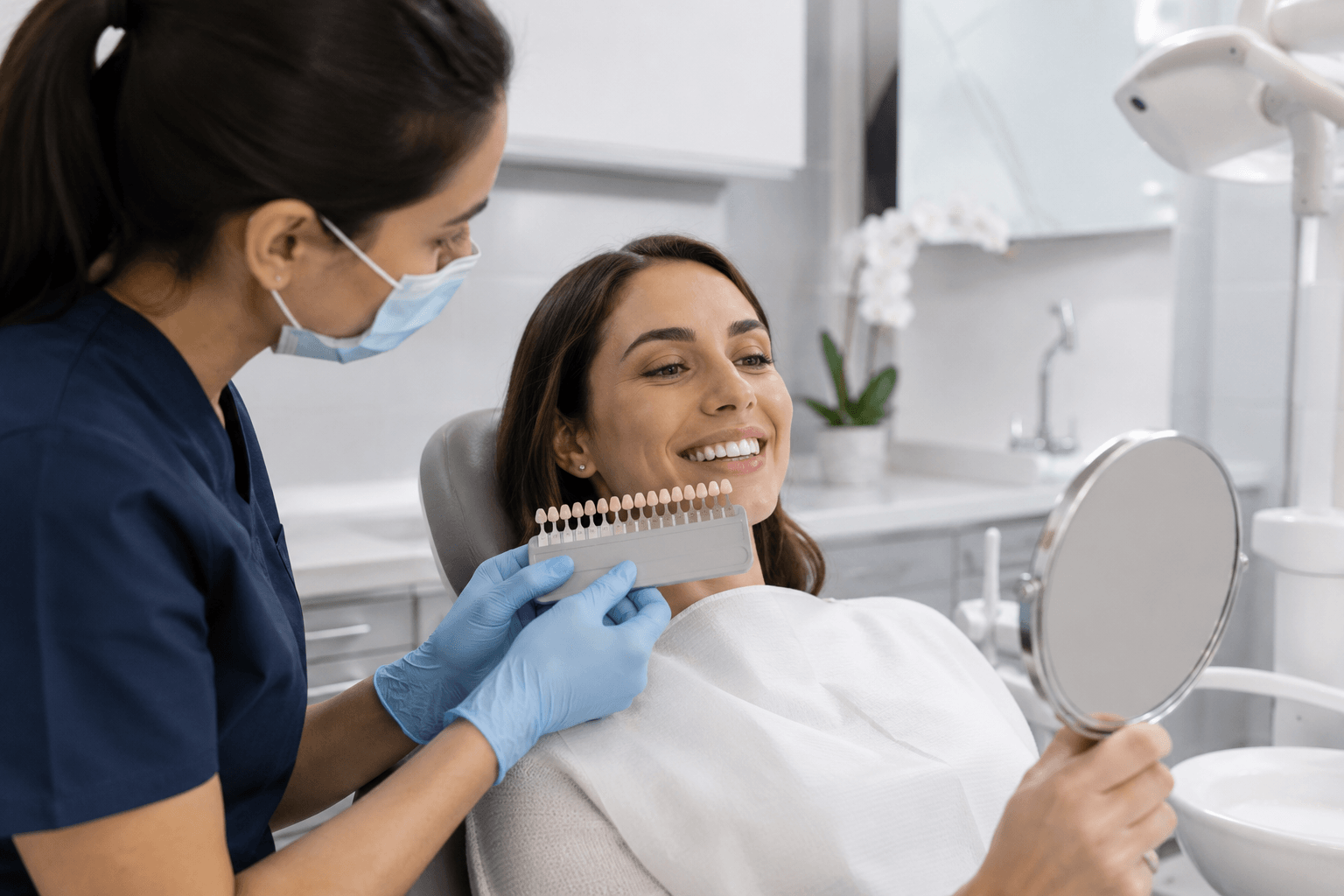
Teeth Whitening delivers its best outcomes when it is treated as a short clinical process rather than a purchase. Assessment establishes whether treatment is appropriate and what result is realistic. Careful preparation and isolation protect comfort and produce evenness. The session itself is straightforward and passive. Aftercare, particularly across the first forty-eight hours, protects what was achieved.
Every stage contributes, and weakness in any one shows up in the result. A perfect session followed by red wine the same evening gives away much of the change, and immaculate aftercare cannot rescue treatment applied to an unsuitable mouth.
Approached properly, the outcome most people describe is not a dramatic transformation but something more useful: teeth that look clean, healthy and well cared for, and the absence of the small self-consciousness that had been quietly present in photographs and conversations. That is a realistic goal, and it is a goal that a well-run Teeth Whitening service achieves reliably.